

If you’ve ever searched for nazi national anthem lyrics translation or wondered what the Nazi-era anthem actually was, you’re not alone. Many people come across references in history books, documentaries, or even internet memes and want a clear, factual explanation. The problem is that information online is often confusing, incomplete, or stripped of context.
The goal here isn’t just to repeat facts, but to help you understand how music was used as a powerful political tool during Nazi Germany, and why these songs still surface today in discussions, searches, and online culture.
What Was the Nazi National Anthem?
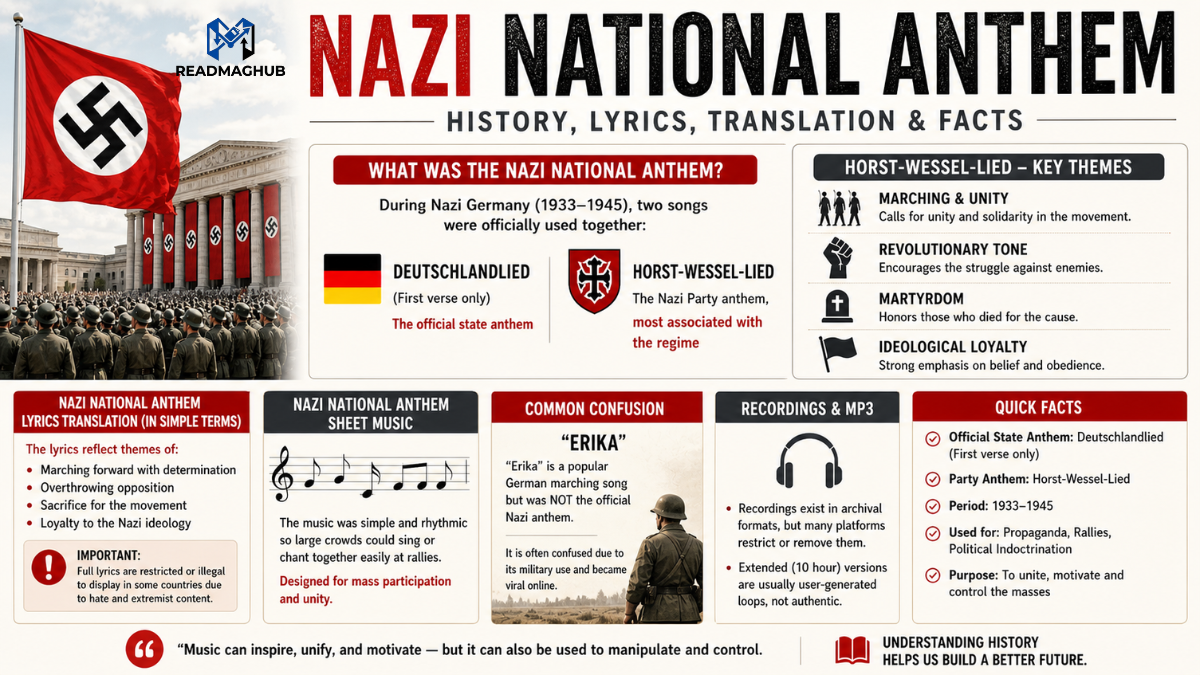
The so-called “Nazi national anthem” wasn’t a single song in the traditional sense. Instead, during Nazi Germany, two songs were officially used together:
- Deutschlandlied (specifically its first verse at the time)
- Horst-Wessel-Lied
What Is the Nazi National Anthem Called?
The most accurate answer is:
- The official state anthem remained Deutschlandlied
- The party anthem—and the one most associated with Nazis—was Horst-Wessel-Lied
Over time, the Horst-Wessel-Lied became the defining symbol of Nazi ideology, which is why people often refer to it as the name of Nazi national anthem, even though technically it was a party song.
Important Context
The lyrics were written in the early 1930s and reflect propaganda themes, including:
- Loyalty to the Nazi movement
- Glorification of struggle and sacrifice
- Calls for unity under ideology
Because of their association with hate and extremism, these lyrics are restricted or illegal to display publicly in some countries today, including modern Germany.
Nazi National Anthem Lyrics Translation (Explained Simply)
When people search for nazi national anthem translation, they usually want a general understanding, not a word-for-word reproduction.
Key Themes in Translation
Instead of reproducing the lyrics, here’s what the translation conveys:
- Marching imagery – References to marching soldiers and unity
- Revolutionary tone – A sense of overthrowing opposition
- Martyrdom – Honoring those who died for the movement
- Ideological loyalty – Strong emphasis on obedience and belief
Unique Insight #1
One overlooked detail is that the Horst-Wessel-Lied was structured to be easy to chant in groups, which made it highly effective at rallies. The rhythm mattered as much as the words.
Nazi National Anthem Lyrics in English: Why It’s Rarely Shown
You might notice that full nazi national anthem lyrics english versions are hard to find or incomplete.
Reasons:
- Legal restrictions in several countries
- Platform policies limiting extremist content
- Ethical concerns about spreading propaganda
Practical Tip
If you’re researching for academic purposes, it’s better to:
- Look for summarized translations
- Study historical analyses instead of raw lyrics
Nazi National Anthem Sheet Music
Searches like nazi national anthem sheet music are usually tied to historical or academic curiosity.
What It Includes:
- March-style composition
- Simple melodic structure
- Designed for mass singing
Unique Insight #2
Unlike classical anthems, this music was intentionally not complex. It was designed so large crowds—regardless of musical skill—could sing it in unison, reinforcing group identity.
What You Should Know
- These recordings exist mostly in archival or historical formats
- Modern platforms often remove or restrict them
- Extended versions (like “10 hours”) are typically user-generated loops, not authentic historical formats
Practical Insight
If you’re studying audio, focus on documentaries or museum archives rather than unofficial uploads, which may lack context or accuracy.
Is “Erika” the Nazi National Anthem?
A common confusion appears in searches like nazi national anthem lyrics erika.
The Truth
Erika was:
- A popular German marching song
- Widely used by soldiers
- Not the official Nazi anthem
Why the Confusion?
- It became viral online
- Frequently used in memes and edits
- Often mislabeled due to its military association
Unique Insight #3
“Erika” survived post-war cultural memory more easily because it lacks explicit ideological content, unlike the Horst-Wessel-Lied, which is heavily tied to Nazi propaganda.
Nazi National Anthem Meme Culture
Searches like nazi national anthem meme reflect how historical material gets reused online.
Why It Happens
- Shock value
- Historical curiosity
- Misunderstanding of context
Important Perspective
While memes may seem harmless, they often strip away the historical weight, which can lead to misinformation or trivialization of serious events.
Common Mistakes People Make
When researching this topic, people often:
- Assume there was only one anthem
- Confuse “Erika” with official Nazi music
- Look for direct translations without context
- Ignore legal and ethical considerations
Better Approach
- Focus on historical explanation over raw content
- Understand why the music mattered, not just what it said
FAQ Section
What was the Nazi national anthem called?
The Nazi regime used two songs: Deutschlandlied as the official anthem and Horst-Wessel-Lied as the party anthem. The latter is most commonly associated with Nazi ideology.
What is the Nazi national anthem?
It refers to the combination of Deutschlandlied and the Horst-Wessel-Lied during Nazi rule, though the latter became the symbolic anthem of the regime.
Why are Nazi national anthem lyrics restricted?
The lyrics are tied to extremist ideology and propaganda. Many countries restrict their use to prevent the spread of hate or glorification of that period.
Is “Erika” the Nazi national anthem?
No, “Erika” is a German marching song but was never an official Nazi anthem. It’s often confused due to its military associations.
Can I find Nazi national anthem lyrics translation online?
You can find summaries and explanations, but full translations are often limited due to legal and ethical concerns.
Why do people search for Nazi national anthem mp3 or 10 hours?
These searches are usually driven by curiosity or internet trends, but extended versions are not historically authentic.
Conclusion
Understanding the nazi national anthem lyrics translation goes far beyond translating words—it’s about recognizing how music was used as a tool for propaganda, unity, and control during one of history’s darkest periods.
Rather than focusing only on lyrics or recordings, it’s more valuable to understand the context, purpose, and impact behind these songs. From the structured simplicity of the music to its emotional influence on large crowds, every element was designed with intent.
If you approach this topic thoughtfully, it becomes less about curiosity and more about learning how culture and communication can shape entire societies—for better or worse.