
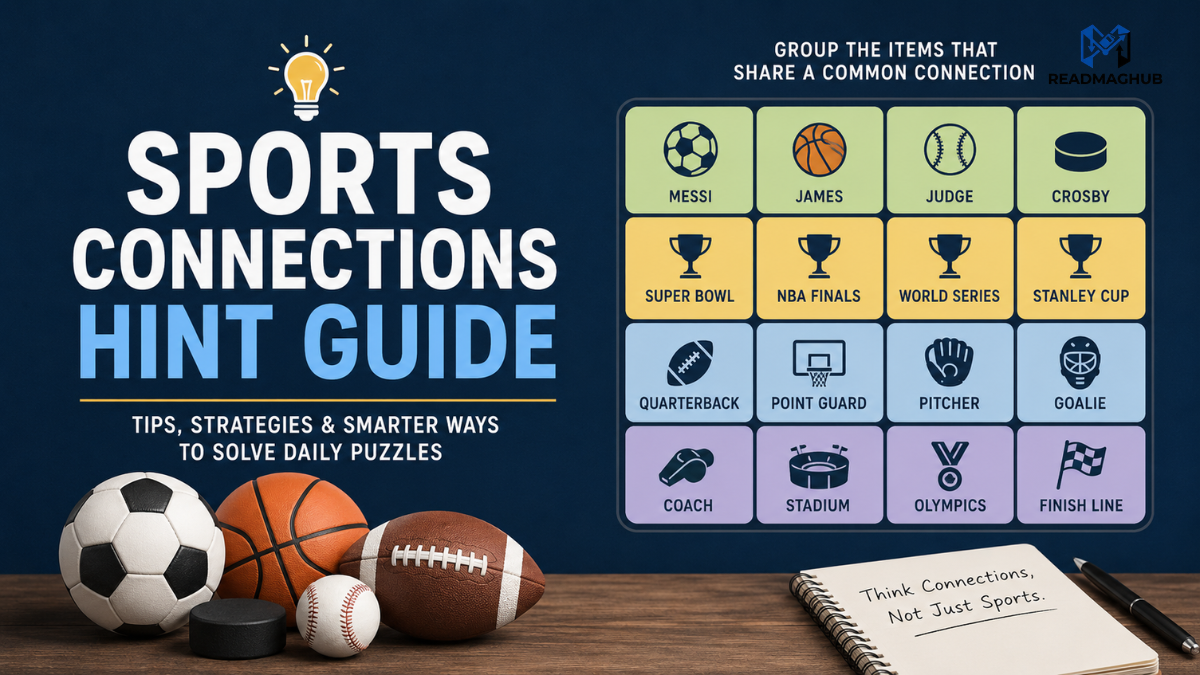

If you’ve ever stared at a Sports Connections puzzle and felt certain that a few clues belong together—only to discover you’re completely wrong—you’re not alone. Daily sports-themed connection games challenge players to identify hidden relationships between names, teams, statistics, events, and terminology. While the concept seems simple, many players find themselves stuck because sports categories often overlap in unexpected ways.
A good sports connections hint can make the difference between solving the puzzle quickly and wasting several guesses on misleading patterns. Whether you’re a casual sports fan or someone who follows multiple leagues year-round, understanding how these puzzles are designed can dramatically improve your success rate.
This guide explains how Sports Connections puzzles work, the most effective solving strategies, common mistakes to avoid, and several advanced techniques used by experienced players. You’ll also discover a few unique insights that most puzzle guides overlook, helping you approach each challenge with greater confidence and accuracy.
What Is a Sports Connections Puzzle?
Sports Connections is a category-based puzzle game where players must group items that share a common sports-related relationship.
A puzzle may include:
- Athlete names
- Team names
- Sports terminology
- Championship events
- Positions
- Statistics
- Equipment
- Coaches
- Historical moments
The objective is to identify which items belong together and determine the category connecting them.
For example:
| Clues | Category |
|---|---|
| Quarterback, Running Back, Wide Receiver, Tight End | Football Positions |
| Wimbledon, Roland Garros, US Open, Australian Open | Tennis Grand Slams |
The challenge comes from misleading overlaps. A clue might fit multiple possible categories, forcing players to think more carefully.
Why People Search for a Sports Connections Hint
Most players don’t want the complete answer immediately.
Instead, they want:
- A small nudge in the right direction
- Confirmation of a suspected category
- Help identifying difficult groups
- Guidance without spoiling the entire puzzle
A quality sports connections hint provides enough direction to keep the puzzle enjoyable while preserving the satisfaction of solving it yourself.
How Sports Connections Puzzles Are Usually Structured
Most puzzles follow a difficulty progression.
Easy Category
These groups are often obvious.
Examples:
- Baseball teams
- Basketball positions
- Olympic sports
Medium Category
Requires more sports knowledge.
Examples:
- Heisman Trophy winners
- Formula 1 constructors
- NHL divisions
Hard Category
Contains misleading clues.
Examples:
- Athletes sharing the same first name
- Stadium nicknames
- Retired jersey numbers
Expert Category
These rely on niche knowledge or wordplay.
Examples:
- Athletes featured on specific video game covers
- Teams with identical mascots
- Players connected through trades
Recognizing this structure helps you prioritize easier categories before tackling the difficult ones.
Practical Method for Solving Sports Connections
Step 1: Scan for Obvious Groups
Start by identifying clues that clearly belong together.
Look for:
- Team names
- Famous athletes
- Sporting events
- Equipment
Create mental clusters before submitting any guesses.
Step 2: Ignore the First Pattern You Notice
One surprising truth about Sports Connections puzzles is that the most obvious pattern is often a trap.
For example:
- Jordan
- Bryant
- James
- Curry
You may immediately think “NBA stars.”
However, the actual category could be athletes whose last names became shoe brands, video game cover athletes, or MVP winners.
Experienced players deliberately challenge their first assumption.
Step 3: Search for Unique Connections
Instead of asking:
“What sport do these belong to?”
Ask:
“What specific thing do these share?”
This mindset uncovers categories faster.
Step 4: Use Process of Elimination
When a few clues remain, their category often becomes clearer.
Many successful players solve the easiest categories first and leave the toughest group for last.
Common Types of Sports Connections Categories
Teams
Examples include:
- NFL franchises
- NBA teams
- MLB clubs
- Premier League teams
Athletes
Groups may include:
- MVP winners
- Olympic champions
- Hall of Famers
- Record holders
Positions
Examples:
- Goalkeeper
- Pitcher
- Point Guard
- Scrum-Half
Championships
Examples:
- Super Bowl
- World Series
- Stanley Cup
- NBA Finals
Equipment
Examples:
- Bat
- Helmet
- Puck
- Racquet
Statistics
Examples:
- RBI
- Touchdown
- Assist
- Save
Understanding these common themes speeds up recognition.
Advanced Strategies Experienced Players Use
Focus on Outliers First
Most beginners search for similarities.
Experts often look for differences.
Ask yourself:
“Which clue feels unusual?”
That outlier often reveals the intended category.
Think Across Multiple Sports
A major trap occurs when players assume every category belongs to a single sport.
Many puzzles mix:
- Football
- Baseball
- Basketball
- Soccer
- Tennis
Keeping an open mind prevents tunnel vision.
Watch for Historical References
Sports Connections creators frequently include:
- Retired athletes
- Defunct teams
- Historic championships
- Classic rivalries
Sports history knowledge can be surprisingly valuable.
Study Naming Patterns
Certain clues may connect through:
- Nicknames
- Initials
- City names
- Mascots
The category isn’t always directly related to gameplay.
Three Unique Insights Most Players Miss
1. Puzzle Creators Intentionally Build False Categories
A common design technique involves creating a believable but incorrect grouping.
For example, four athletes might all be Olympic medalists, but the real category is athletes who also played professional football.
When multiple clues seem to fit together perfectly, double-check before submitting.
2. The Hardest Category Is Often the Simplest
Many players overthink the final group.
Ironically, the remaining clues frequently share a straightforward connection that becomes obvious once other categories are removed.
Avoid assuming the last category must be extremely complicated.
3. Sports Knowledge Isn’t Always the Biggest Advantage
People often believe experts in sports automatically perform better.
In reality, pattern recognition matters just as much.
Many puzzles reward logical thinking over encyclopedic sports knowledge.
Common Mistakes That Lead to Failed Attempts
Guessing Too Early
Submitting guesses before reviewing all clues usually wastes attempts.
Ignoring Alternate Meanings
Some sports terms have multiple interpretations.
For example:
- Draft
- Pitch
- Match
- Drive
Always consider secondary meanings.
Overlooking Wordplay
Sports Connections puzzles frequently include subtle language tricks.
A clue may appear sports-related but actually connect through spelling, pronunciation, or naming conventions.
Forcing Categories
If a group requires complicated explanations, it may not be the intended answer.
The best categories typically have a clear, elegant connection.
Real-Life Example of Solving a Puzzle
Imagine these clues:
- Wimbledon
- Masters
- Augusta
- Centre Court
- Green Jacket
- Forehand
- Birdie
- Bunker
At first glance, everything appears sports-related.
However, closer inspection reveals two categories:
Golf Terms
- Birdie
- Bunker
- Augusta
- Green Jacket
Tennis Terms
- Wimbledon
- Centre Court
- Forehand
- Masters
Breaking the puzzle into smaller groups simplifies the process.
How to Improve Over Time
Like any puzzle format, improvement comes through repetition.
Helpful habits include:
- Following multiple sports.
- Learning major championships.
- Reviewing historical athletes.
- Understanding sports terminology.
- Practicing daily.
After several weeks, you’ll start recognizing recurring puzzle patterns.
FAQ
What is a sports connections hint?
A sports connections hint is a clue that helps players identify categories in a sports-themed connection puzzle without revealing the full solution. It provides guidance while preserving the challenge of solving the puzzle independently.
How do I get better at Sports Connections puzzles?
Focus on identifying obvious categories first, use process of elimination, and avoid making quick assumptions. Regular practice helps you recognize common category patterns and puzzle tricks.
Are Sports Connections puzzles based only on professional sports?
No. Many puzzles include college athletics, Olympic events, international competitions, sports history, equipment, statistics, and terminology. Categories can span a wide range of sports topics.
Why do Sports Connections puzzles feel tricky?
Puzzle creators intentionally include clues that fit multiple categories. This creates false patterns designed to challenge players and encourage deeper analysis before making guesses.
Can beginners solve Sports Connections puzzles?
Absolutely. While sports knowledge helps, strong pattern-recognition skills are equally important. Many successful players solve puzzles through logical grouping rather than expert sports expertise.
Do Sports Connections puzzles repeat themes?
Yes. Common themes such as championships, positions, famous athletes, team names, and sports terminology often appear repeatedly. Familiarity with these themes improves solving speed over time.
Conclusion
Sports Connections puzzles are far more than simple sports trivia. They combine knowledge, logic, observation, and pattern recognition into a daily challenge that rewards careful thinking. The best approach is to identify obvious groups, question first impressions, and look for precise connections rather than broad similarities.
A useful sports connections hint isn’t about giving away answers—it’s about helping you see the puzzle from a different angle. By understanding common puzzle structures, avoiding frequent mistakes, and applying advanced solving techniques, you’ll improve your accuracy and enjoy the experience far more. The next time a puzzle seems impossible, remember that the solution is often hiding in plain sight.